 The Sandy Mush Community Center homeschool science fair is becoming one of those community traditions that doesn’t just show what kids know — it shows who they’re becoming.
This was our third year, and the room felt fuller in every way: more projects, more voices, more confidence. There were 14 presentations, but more scientists than that, because several projects were shared by partners and small teams.
And what a gift it is to watch that happen on a Tuesday morning: kids standing up in front of neighbors and friends, explaining what they tried at home, what surprised them, and what they learned — with parents and caregivers in the background, cheering them on and helping turn curiosity into something you can measure.
Some projects were loud and hands-on — things you could shake, pour, or ignite (safely). Some were slow and steady, the kind that takes days or weeks. Some ended with the best words a scientist can say: “I was wrong.” Not embarrassed — proud, because it meant the experiment worked.
The goal wasn’t to look perfect. The goal was to learn.
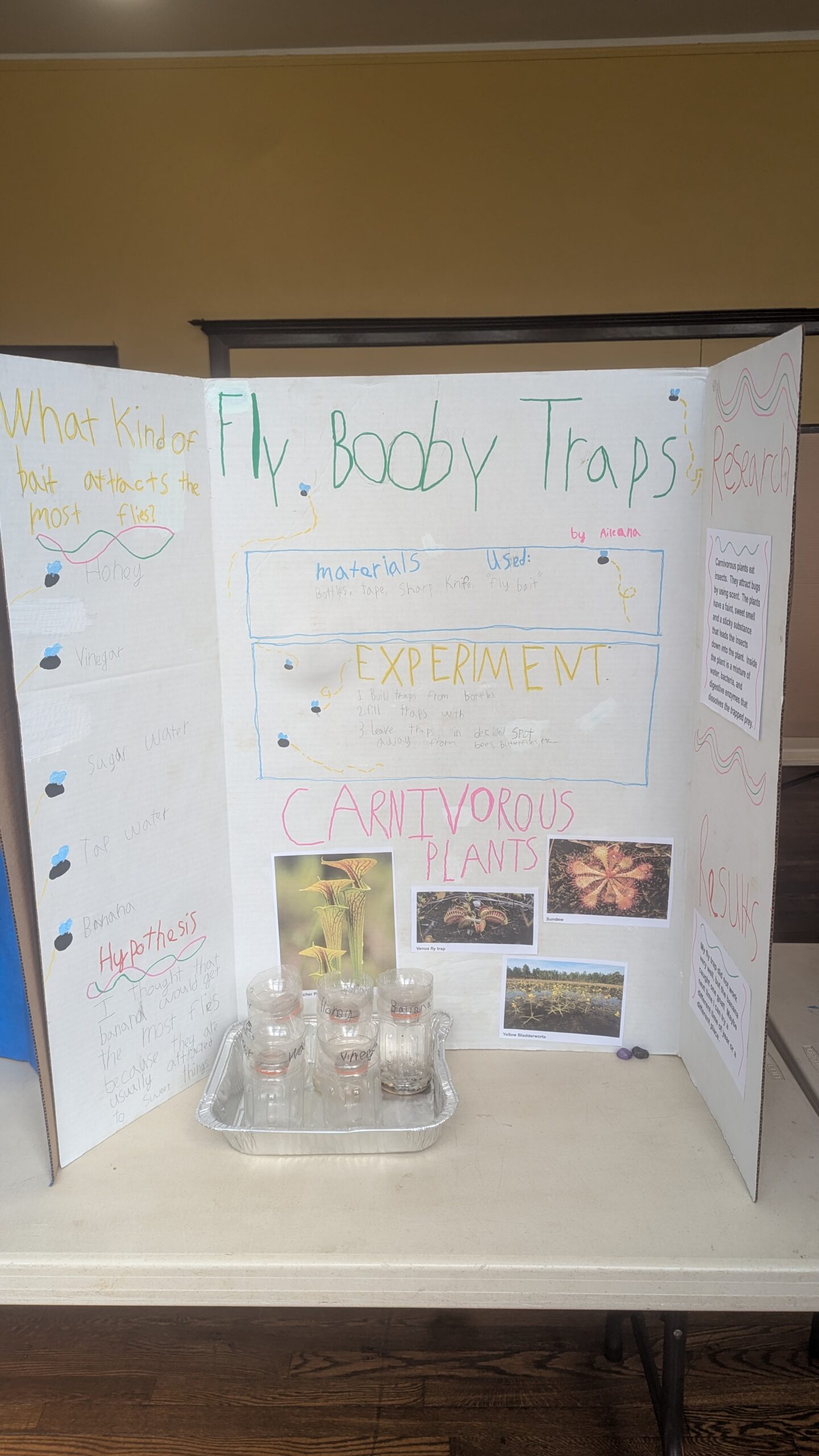
1) Aileana — “Fly Booby Traps” (solo)
Aileana’s project had that perfect blend of creativity and real-world problem solving: a kid noticing a problem (flies), then asking the most practical scientific question possible — what kind of bait attracts the most flies?
Aileana tested a lineup of everyday baits — honey, vinegar, sugar water, tap water (as a control), and banana — and built traps using plastic bottles, setting them out thoughtfully (including away from beneficial insects like bees and butterflies). There was also a wonderful connection to nature built into the display: carnivorous plants like Venus flytraps, pitcher plants, and sundews — living examples of how “trapping” works in the wild.
The results were honest (and that honesty is the win): the traps didn’t work very well, but the banana trap caught one gnat — enough of a clue to spark the next step. And Aileana already had the scientist mindset ready: maybe the test needed a different time of year or a different location.
Q&A (from the room):
- “Where did you get the flytrap from?” Aileana shared it came from their chicken coop (an old coop where garbage is now stored).
- “What month were you collecting the data?” (A good reminder that season and timing can change results.)
2) Noli — “Noli’s Balloons!” (solo)
Noli’s project had the kind of joyful honesty that makes a science fair feel like a celebration instead of a test. Her big question was simple and perfect: do balloons still fly if you put marbles inside them? Noli’s hypothesis was confident — she expected the balloons wouldn’t fly with any marbles at all.
So she did what real scientists do: she didn’t argue with the idea, she tested it.
Noli ran the experiment like a true series of chapters — starting with one marble and working her way up to seven, balloon by balloon. After her mom helped blow them up, Noli released each balloon to see what would happen, and she even weighed them so she could connect what she saw to real numbers. And then came the moment that made everyone smile: Noli discovered her hypothesis was “99% wrong.” The balloons did fly — just not all in the same way. As the weight changed, the balloons moved at different paces, like each one had its own personality.
And the presentation itself was pure Noli — science with style. The tri-fold background was hand-painted in a soft lavender-blue wash, stamped with playful shapes (hearts, circles, squares). The center panel showed a grid of photos capturing Noli’s expressions as the experiment unfolded, while the side photos showed behind-the-scenes work: labeling balloons, counting marbles, and recording data. Best of all, she brought the experiment into the room physically: the actual deflated balloons, labeled 1 through 7, lined up in front like a little museum of trials.
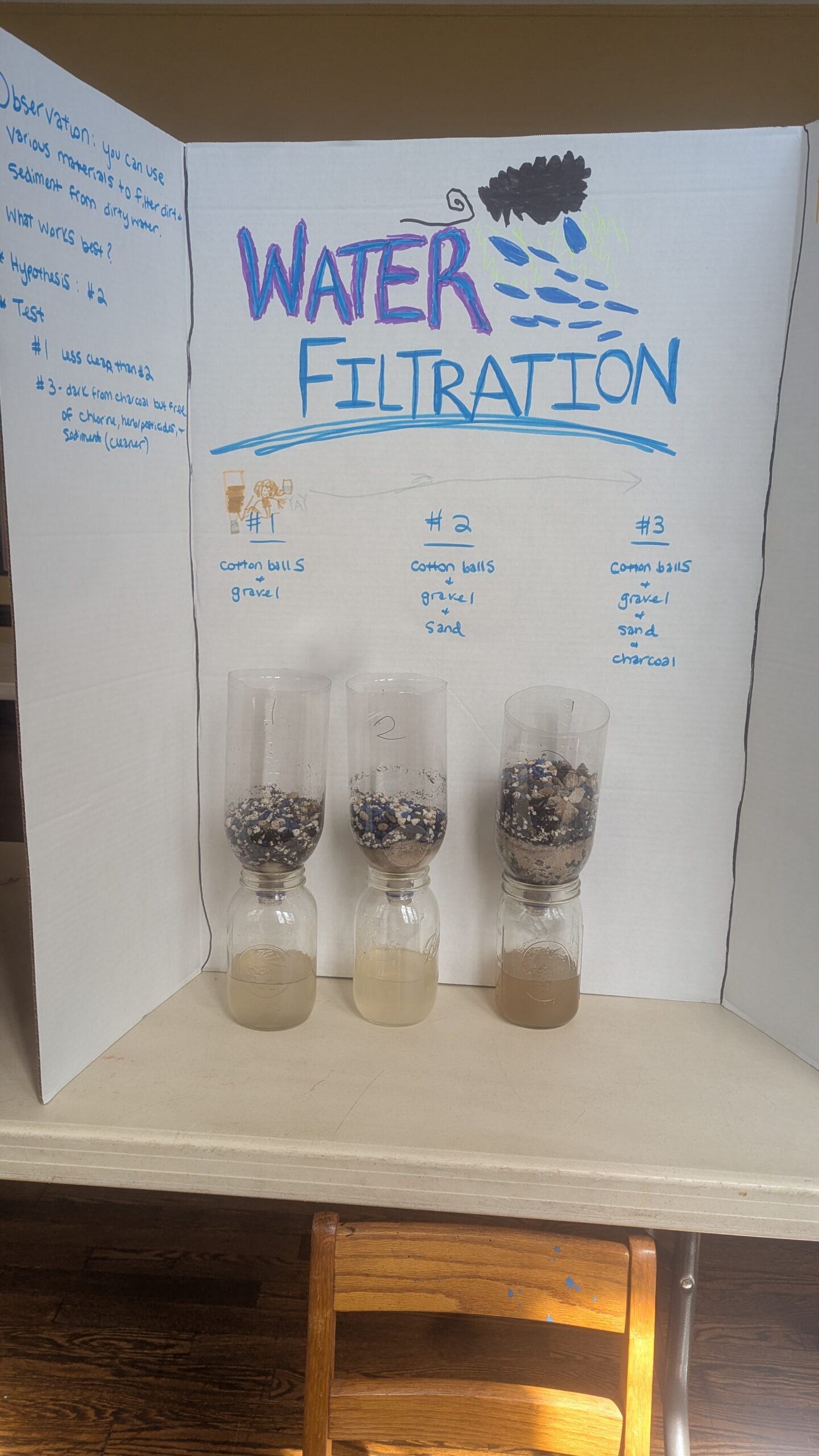
3) Alora — “Water Filtration” (solo)
Alora brought one of the most quietly powerful themes of the whole science fair to the table: water can look clean and still not be clean — and sometimes the “dirtiest-looking” jar is doing the most important work.
This was a solo project by Alora, and one of the sweetest moments of the fair was seeing her parents help her present — she was one of our youngest presenters, and she did a great job sharing her work. Using inverted 2-liter bottles as funnels, she built filters in layers and collected the water below in mason jars, turning the table into a mini water lab.
Their filter tests built up like levels in a game:
- Filter #1: cotton balls + gravel
- Filter #2 (her predicted winner): cotton balls + gravel + sand
- Filter #3: cotton balls + gravel + sand + charcoal
The results challenged instincts in the best way. Adding sand helped — Filter #2 produced the most visually clear water. But Filter #3 looked darker because of charcoal dust, and the team understood the deeper point: charcoal isn’t just about catching sediment. It can help remove chemicals like chlorine and pesticides that the other materials can’t.
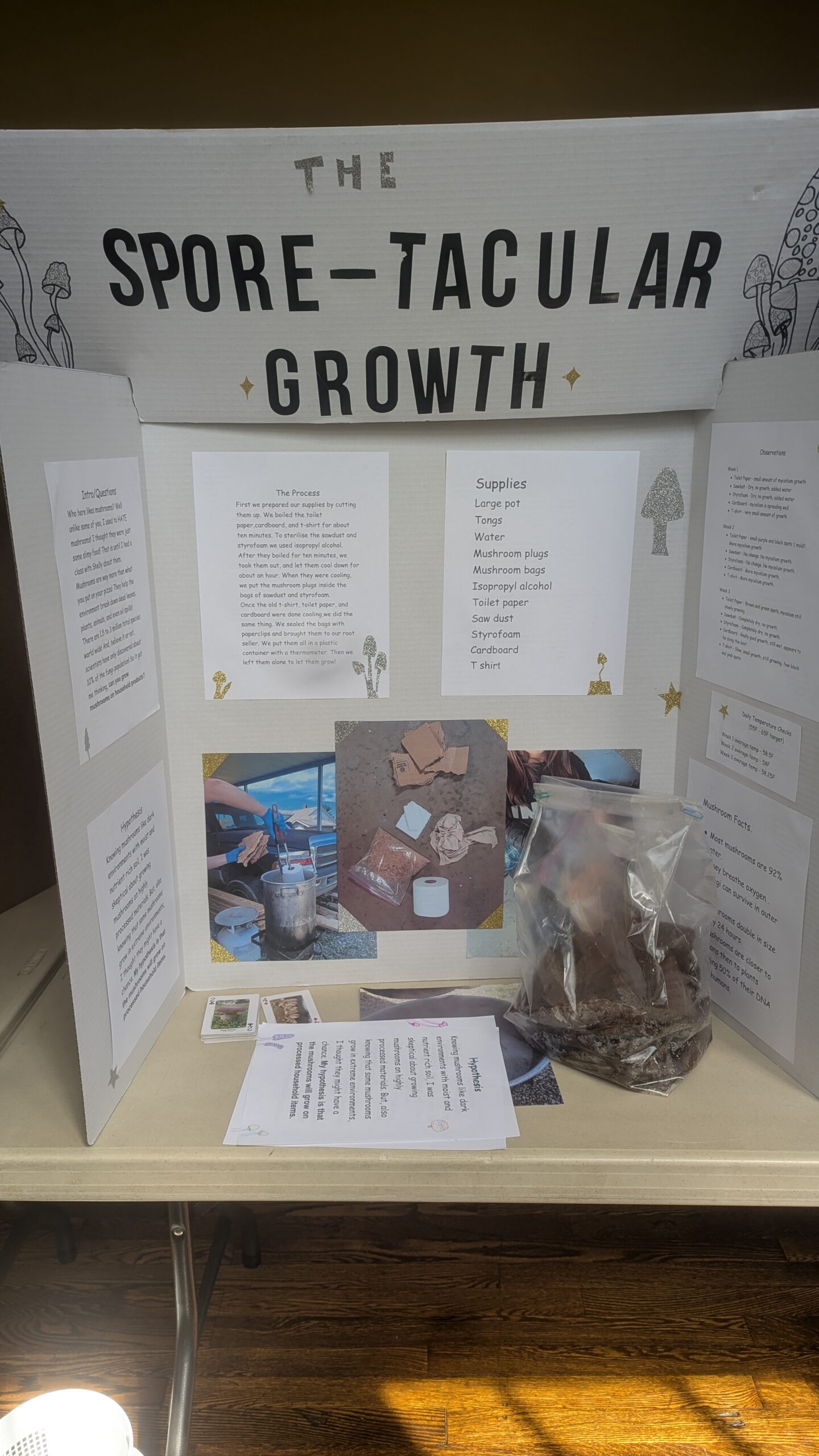
4) Alma — “The Spore-tacular Growth” (solo)
This project had everything you want in a science fair entry: a clever title, a brave question, and the kind of patience that only comes from someone who genuinely wanted to know the answer.
“Can you grow mushrooms on household products?” The student tested whether fungi could grow on non-traditional, processed household materials — and did the unglamorous work that makes experiments real: sterilizing, prepping, logging temperatures, and waiting.
Toilet paper, cardboard, and an old t-shirt were boiled for ten minutes to sterilize them. Sawdust and styrofoam were treated with isopropyl alcohol. Once everything cooled, mushroom plugs/spawn were added to bags and kept at a steady 55°F–65°F, with temperature logs.
Cardboard was the champion — by Week 3 it showed “really good growth.” Toilet paper and the t-shirt showed mycelium but also contamination (purple/black/green mold spots). Sawdust and styrofoam stayed dry with zero growth even after extra water.
The board included fun mushroom facts, identification cards, and a clear bag showing the white fuzzy mycelium spreading — proof you could see.
Q&A (from the room):
- “Do you know if your sawdust was…?” (Because sawdust usually works well.) The student explained their sawdust was clean, and they wondered if the heat pads underneath made it too hot.
- “What kind of mushroom did you grow?” They shared they ordered oyster mushrooms, a strong beginner-friendly variety.
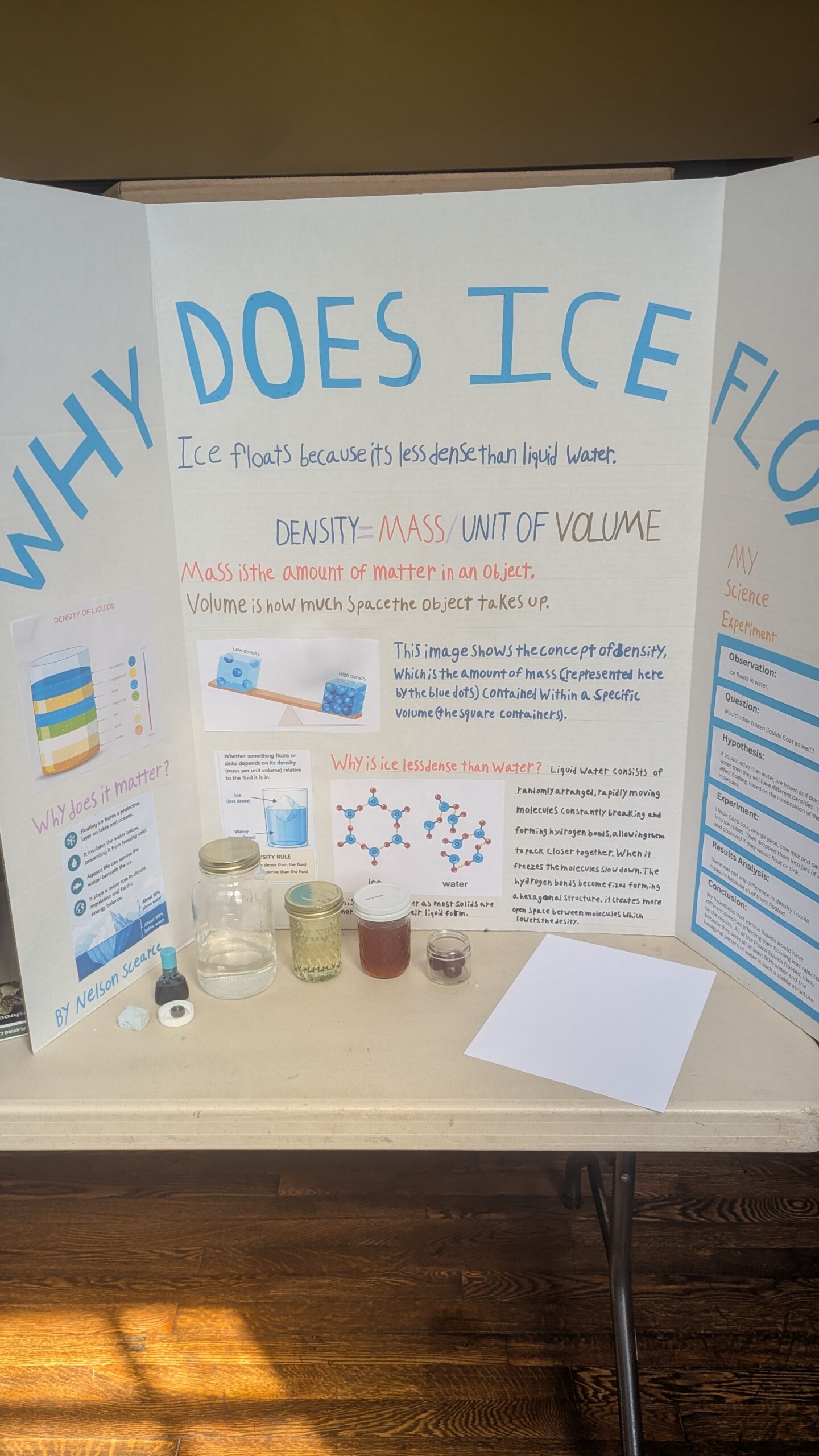
5) Nelson — “Why Does Ice Float?” (solo)
Nelson’s board had the rare quality of feeling both smart and inviting — the kind of project that makes people stop, smile, and stay a while because it takes a familiar everyday mystery and opens it up like a story.
Nelson used “Why does ice float?” as a doorway into density — clearly explained as mass divided by volume — and then into the secret architecture of water: when water freezes, molecules form a stable hexagonal lattice that spaces them farther apart, making ice less dense than liquid water.
Then Nelson tested a new question: would other frozen liquids behave differently? He froze Coca-Cola, orange juice, cow milk, and oat milk into cubes and dropped them into water. They all floated, and Nelson explained why: those liquids are mostly water, so the water structure still dominates.
He also explained why floating ice matters — it can form an insulating lid on lakes, helping aquatic life survive the winter.
Q&A (from the room):
- “Why does the dirt float?” Nelson explained some materials float because they’re lighter/less dense, and some sink when they’re waterlogged.
- “How do you know the honey would sink into the water?” Nelson answered simply: honey is more dense than water.
6) Cloud & Beau — Lightning & Thunder (group)
This group didn’t just explain storms — they performed the weather for the room, and you could feel how well they’d practiced together.
They started by building the story from the ground up: how charges separate inside a cloud, how static electricity builds, and why a lightning strike is really the atmosphere trying to “balance the books.” Then they taught one of the most useful storm tricks there is — the Flash-to-Bang method — in a way even the youngest kids could repeat: count the seconds from flash to thunder — and that number gives you about how many miles away the storm is.
What made their board stand out was how team-driven it felt. One student pointed to diagrams, another handled the timing explanation, and another kept the audience engaged — like a mini weather crew.
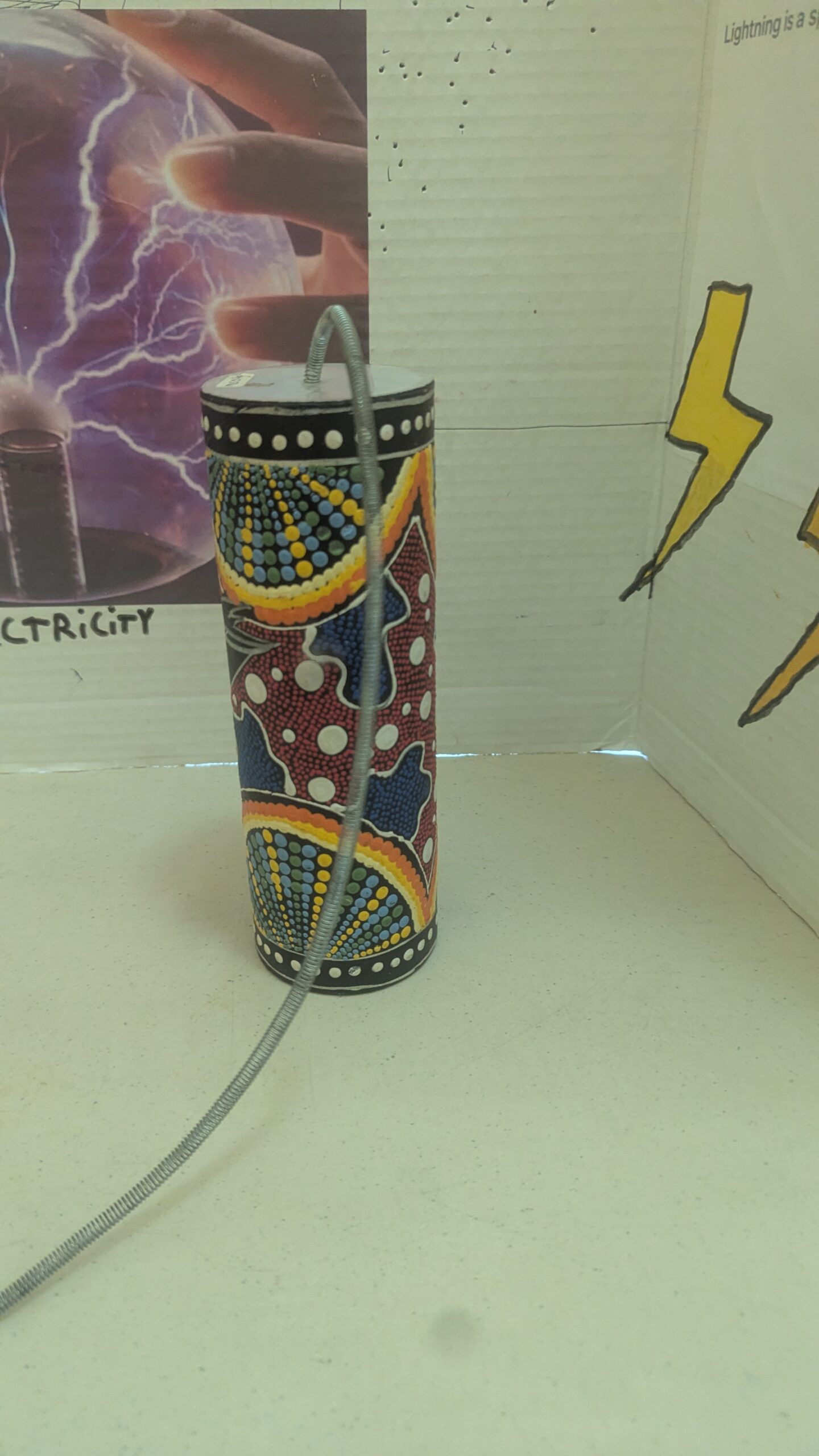
And then came the crowd favorite: an interactive Thunder Tube (spring drum), decorated with dot art, that made a surprisingly realistic thunder-rumble when shaken. It turned the science into something you could hear and feel, not just read.
Q&A (from the room):
- Someone asked if learning the science made them feel less afraid of lightning — and the presenter said yes, understanding it helped.
- Another question: can you die from being struck by lightning? The group explained it depends (including how big/hot the strike is), and they shared one more fact: thunder’s rumble comes from how hot the air gets during lightning.
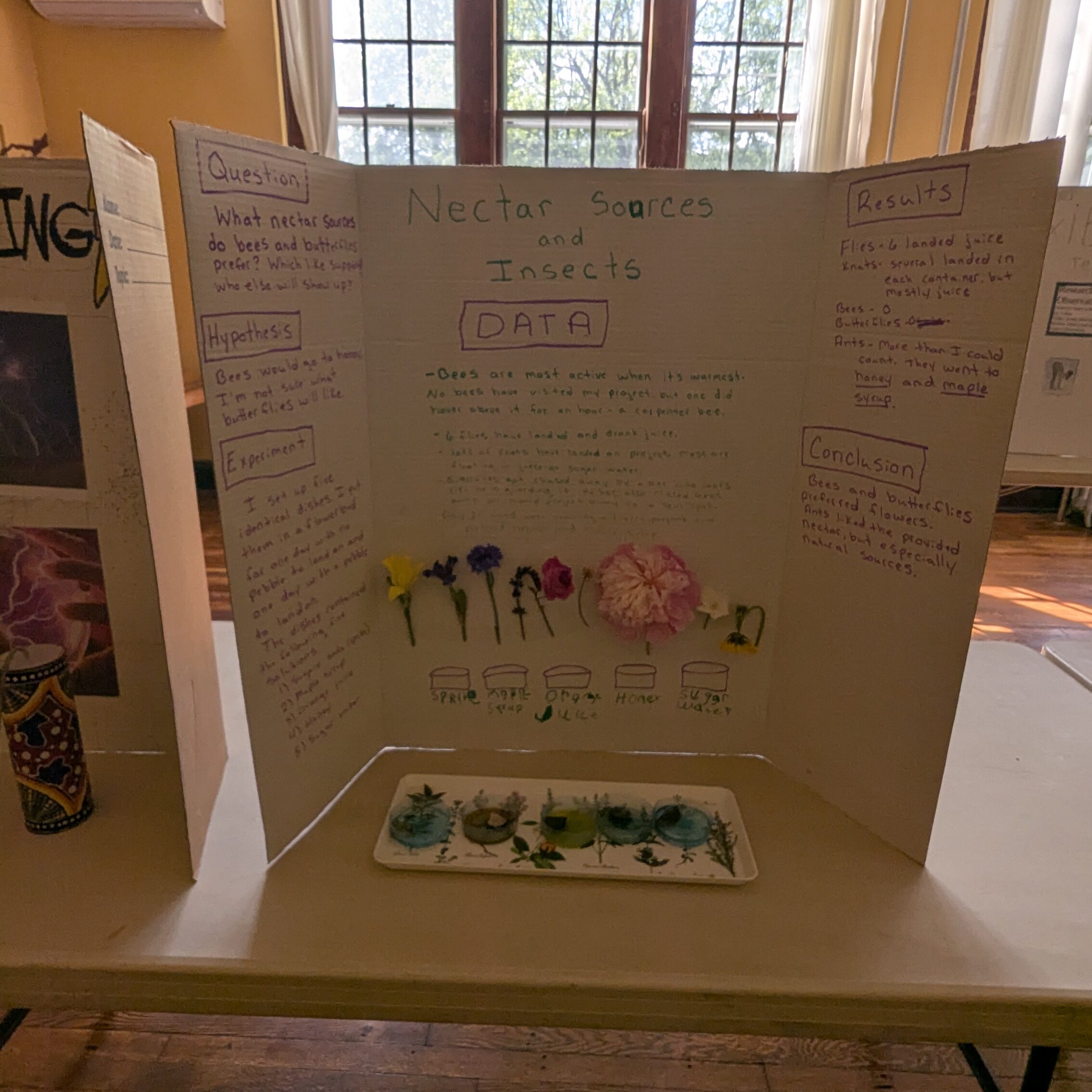
7) Lilley— “Nectar Sources and Insects” (solo)
This project had true backyard-scientist spirit: set up a fair test, then let nature answer honestly — and then be brave enough to report the answer even when it isn’t the one you hoped for.
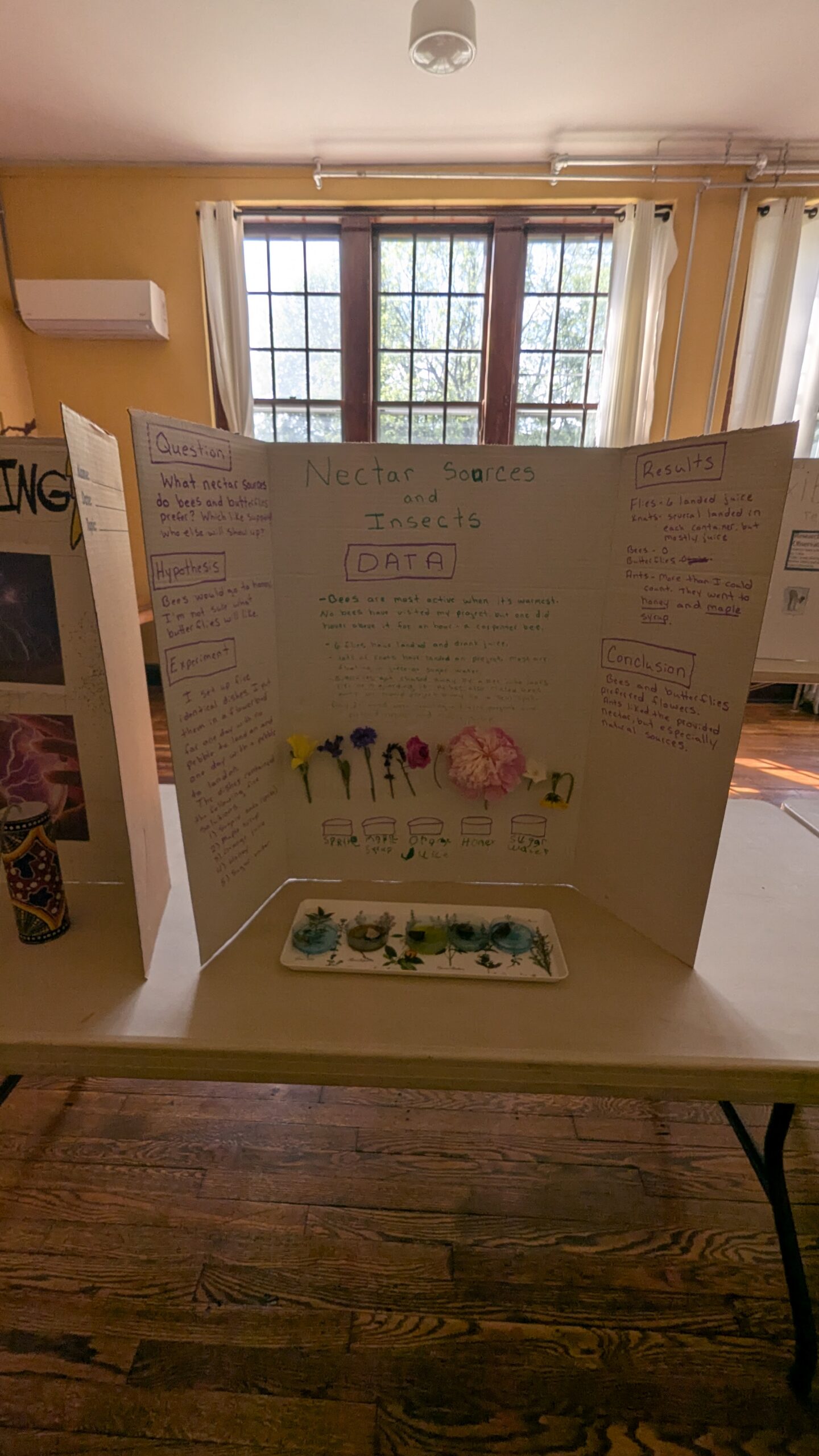
The question was wonderfully specific: what sweet sources do bees and butterflies prefer — and would a “landing pebble” help? The student set out five dishes in a flowerbed — Sprite, maple syrup, orange juice, honey, and sugar water — and watched to see who showed up.
And nature gave a result that was both funny and important: 0 bees and 0 butterflies landed on the dishes. They preferred real flowers. But that didn’t mean nothing happened — the backyard still had plenty to say.
The student described waking up and finding the setup crawling with life: ants were all over maple syrup and honey, and they even found evidence that flies liked the orange juice (including some that ended up floating in it). They also shared a small “reset” moment that felt very real: the first location turned out to be near carpenter bees, and those bees guarded the area and chased other insects away — so the student moved the whole experiment to a different flowerbed and tried again.
That kind of observation is the heart of science: not just counting “the winners,” but noticing the story the environment is telling you.
The presentation itself had a lot of charm: handwritten notes on recycled brown cardboard, real dried flowers taped on, diagrams of the five dishes — and the actual decorative glass dishes displayed on a floral tray.
Q&A (from the room):
- People asked about the flies (and how they knew orange juice was a favorite): the student mentioned some were even floating in it.
- There were questions about how many ants showed up — and which dishes they were in (maple syrup and honey).
8) Kai & Sequoia — “WATER FILTRATION” (group)
Their Water Filtration presentation worked because it was instantly visual: you could see the dirty water go in, and you could see the results collected below.
They walked the room through their setup like a real team of demonstrators: dirty water in the top, then different materials layered inside bottle-funnels, then the results collected below. And as they talked, they kept returning to the same big idea: fast water isn’t always better water.
The group tested four filter designs using recycled plastic bottles as funnels, and they tracked both time and how the water looked:
- Sock & rocks: 20 seconds — the fastest run, but also the roughest result
- Coffee filter + sand: 2 minutes — better structure, but it still didn’t filter well
- Cotton + charcoal: 3 minutes — slower, but clearly more effective
- Wicking method: it took 4 hours 20 minutes to get a single drop — and they shared that it was essentially an all-day (nearly 24-hour) run for that method — but the result was “crystal clear!”
What made their board so strong wasn’t just the numbers — it was how clearly they made the comparison. The display laid out the methods so you could understand them at a glance, and the jars made it impossible to argue with the outcome: different materials create different results, and the “best” method depends on what you’re measuring.
Their conclusion was wonderfully mature: sometimes the cleanest result comes from the slowest, most patient method.
Q&A (from the room):
- “How in the world did you transport it?” The group laughed and admitted it got super wet — and everything went into a bin.
9) Rowan — “How Does a Fire Extinguisher Work?” (solo)
Rowan’s presentation took a big, real-world question — how does a fire extinguisher actually work? — and made it feel clear, safe, and understandable in minutes, with the kind of confidence that made the whole room pay attention.
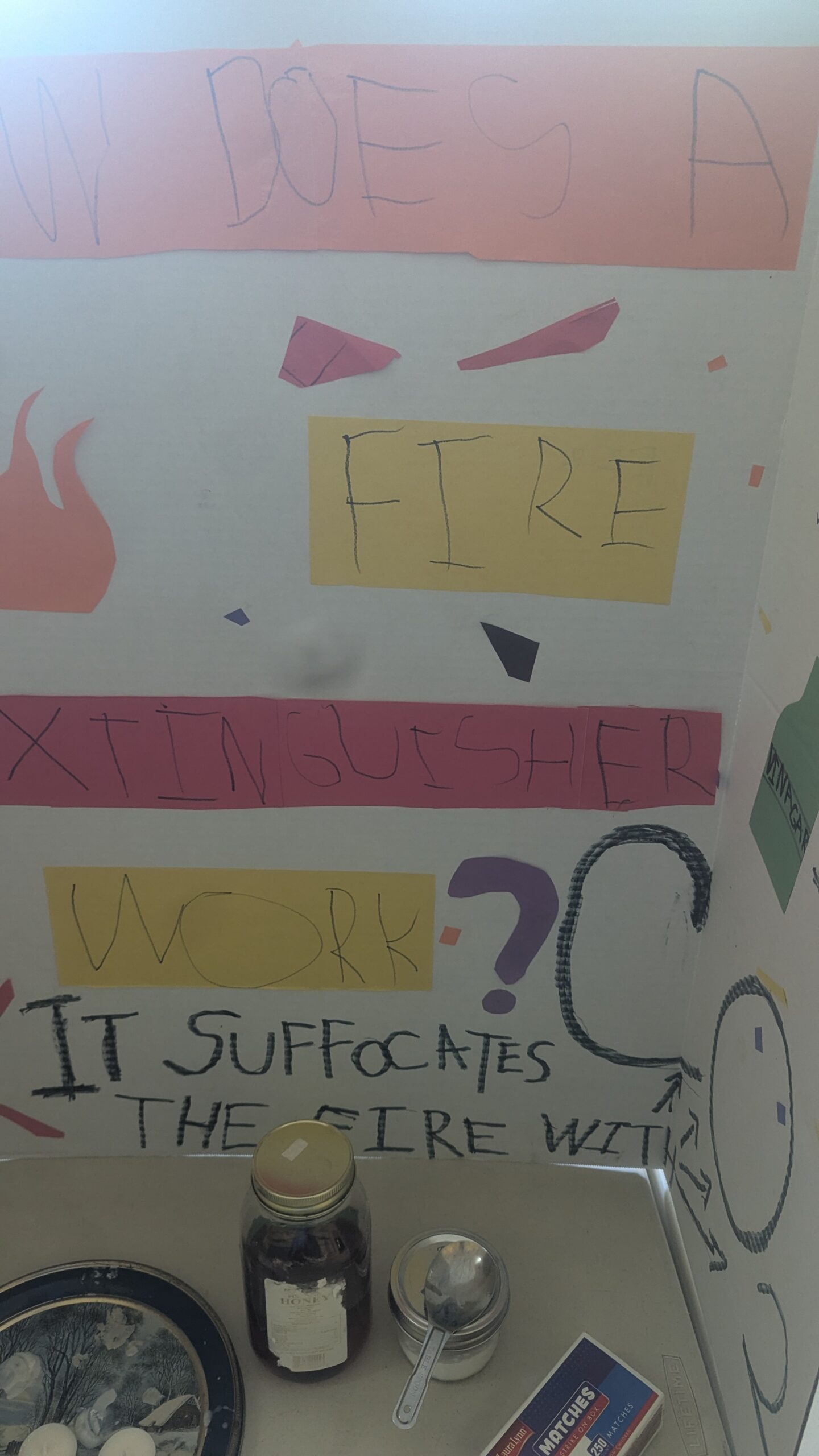
He started with the core idea: fire needs oxygen. Take the oxygen away, and the flame can’t keep going. Then Rowan walked everyone through a simple chemistry demo that created that “oxygen-displacing” effect in real time. Using baking soda (a base) and vinegar (an acid), they generated CO₂ gas, explaining how CO₂ can “suffocate” a flame by pushing oxygen out of the immediate space around it.
What made it land wasn’t just the explanation — it was the presentation. The board used bright cut-out letters, hand-drawn flames, and clear diagrams so even the younger kids could follow along, and the tabletop setup (matches, jars, spoon) made it feel like something you could actually recreate (carefully) to learn how the science works.
And Rowan handled the “live-demo” part like a pro: they slowed down, narrated what was happening, and let the reaction settle so everyone could see the result.
There was a little “science fair theater” to it, too — the kind that only happens when you’re doing a real experiment live: a quick reset, a second try, and then the moment when it worked and the chemistry clicked for the room.
Your content goes here. Edit or remove this text inline or in the module Content settings. You can also style every aspect of this content in the module Design settings and even apply custom CSS to this text in the module Advanced settings.
10) Emerson & Everett — Incubator / Hatching (group)
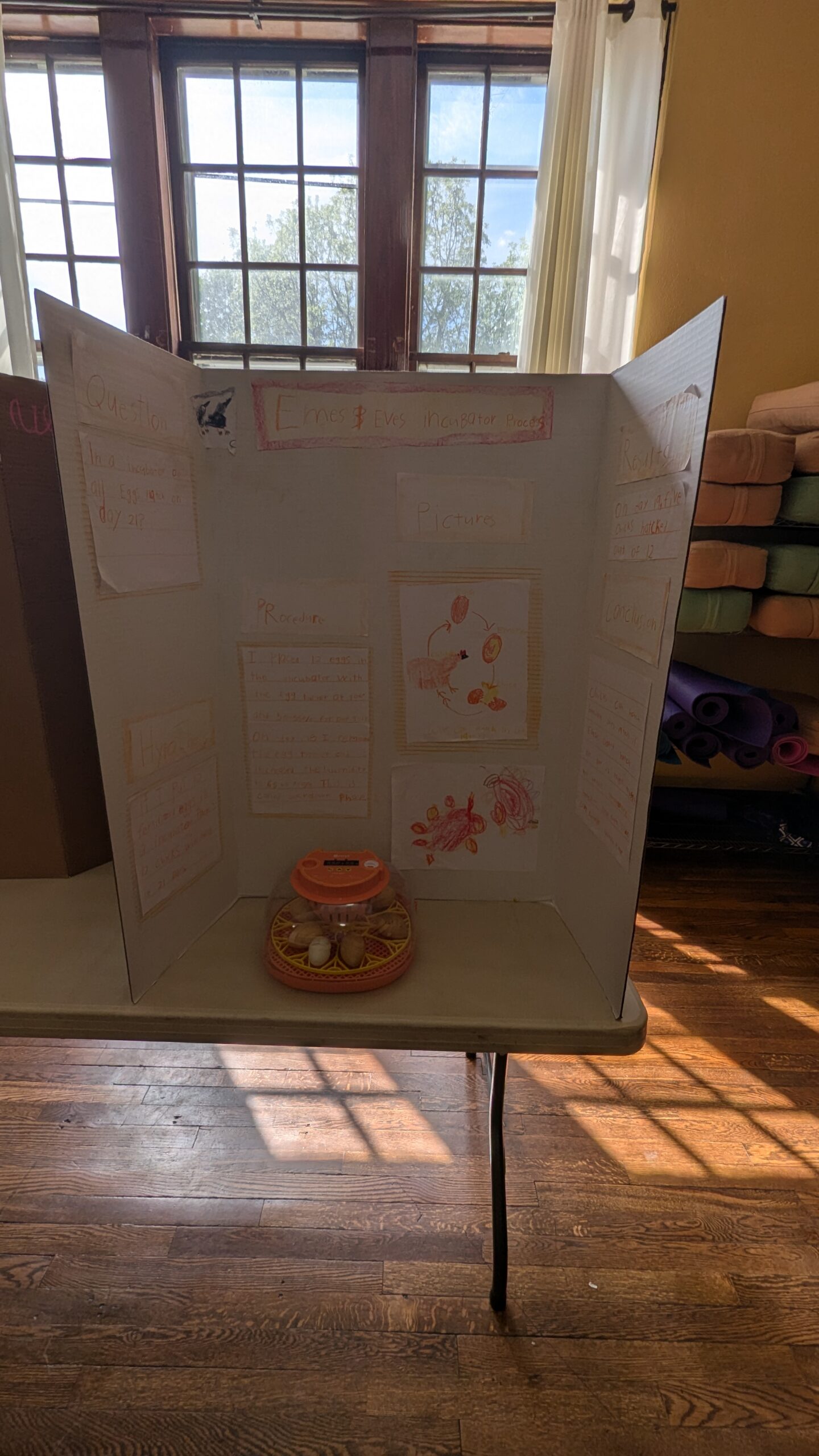
Emerson and Everett chose a question that sounds simple until you’re the one responsible for it: “In an incubator, do all eggs hatch on day 21?” And they didn’t just research the answer — they lived it, day by day, as caretakers and observers.
Their hypothesis was hopeful and bold: if they placed 12 fertilized eggs into an incubator, then 12 chicks would hatch in 21 days. That’s the kind of prediction that makes you root for the result — and also sets up the real lesson science loves to teach: nature doesn’t always follow our neat timelines.
When the results came in, the story got more interesting (and more honest). Five chicks hatched by day 19, and the project highlighted what experienced hatchers already know: there’s a window — roughly days 19–23 — where hatching can happen. Emerson and Everett also understood why that window exists: humidity matters, temperature consistency matters, egg health matters, and small differences early on can show up as big differences at the finish line.
What made their display memorable was the feeling that you were seeing a real process, not just a finished poster. With the incubator right on the table, plus handmade drawings and notes that tracked what happened over time, their board told a full narrative: not just “what we learned,” but what we did, what we expected, what actually happened, and what we’d do differently next time.
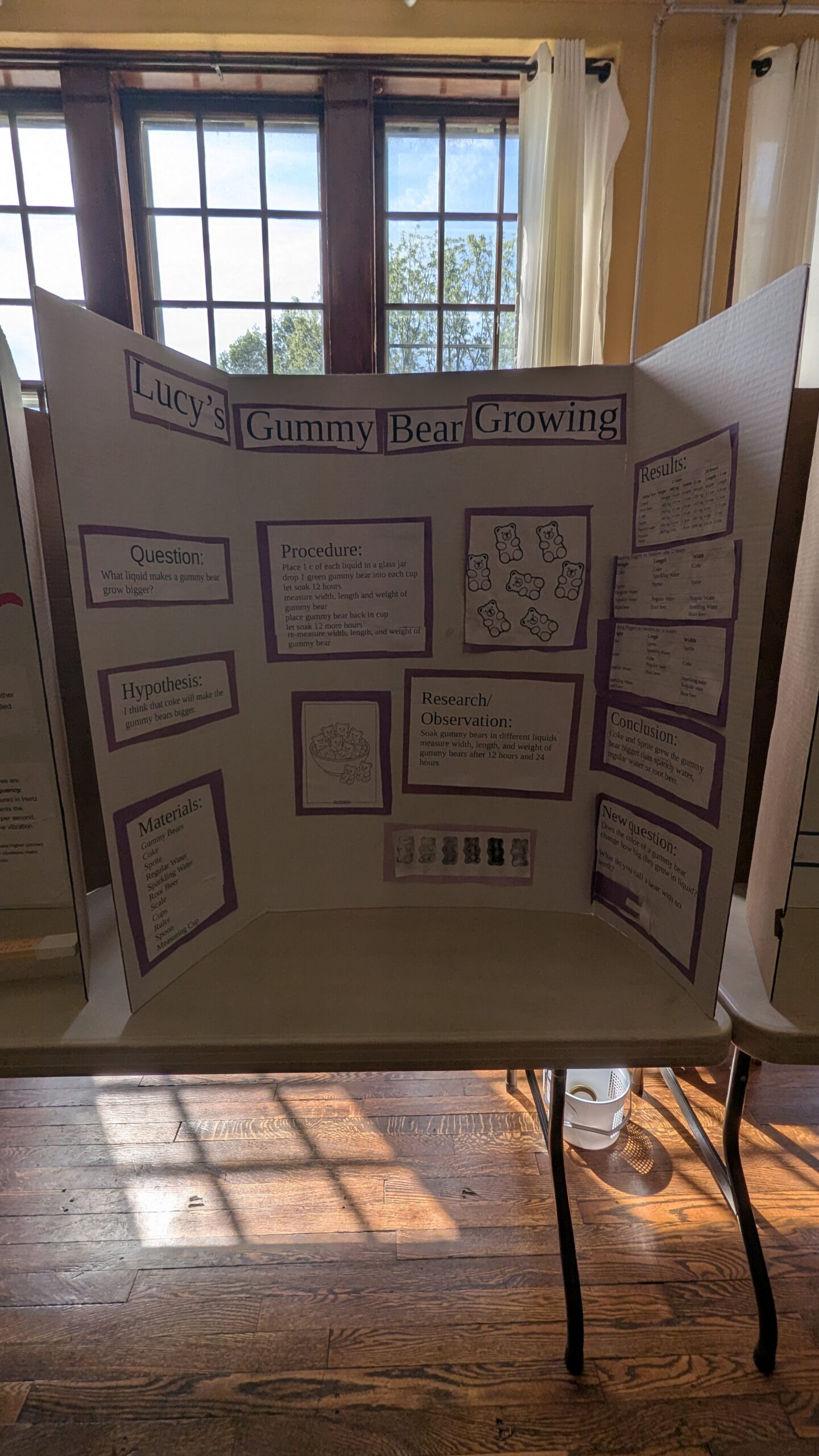
11) Lucy — “Lucy’s Gummy Bear Growing” (solo)
Lucy turned candy into a real science lesson about osmosis — and she presented it with the kind of clarity that makes you think, “Oh, I get it now.”
Her experiment was structured like a real lab test: she measured and weighed gummy bears, soaked them in different liquids, and then recorded the “before” and “after” changes (height, width, and weight). You could tell she wasn’t just guessing — she was tracking evidence.
Her board explained the “why” in a kid-friendly way that was still accurate: gummy bears are made with gelatin, and gelatin behaves like a sponge — it pulls water in and swells. That simple explanation made the results feel logical instead of mysterious.
And the presentation itself had a ton of charm. The layout was clean and easy to follow, the colors were consistent, the sections were clearly labeled, and the gummy bear images gave it personality — polished, but still unmistakably Lucy.
12) Emme — “Emme’s Flexibility Test” (solo)
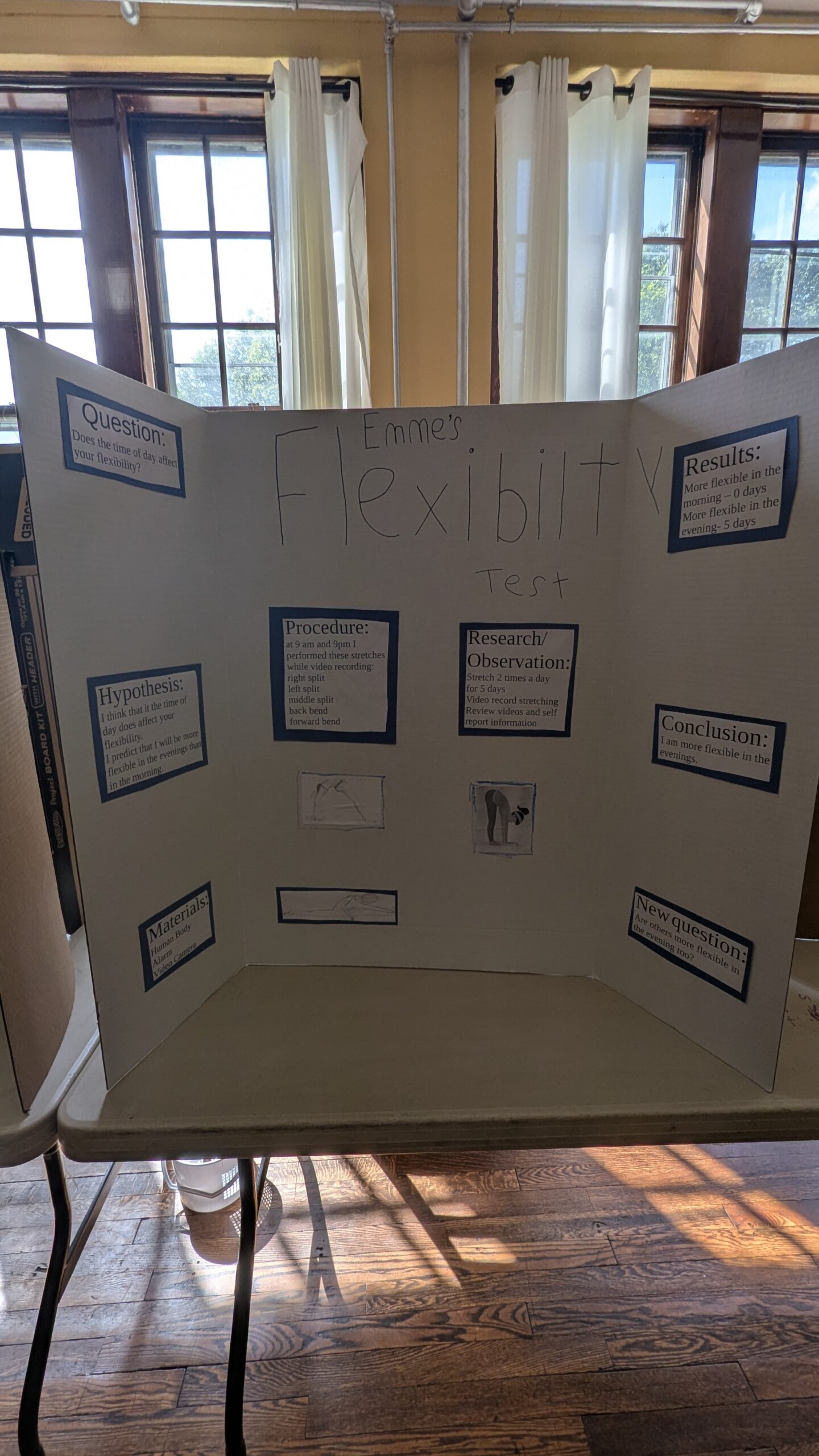
Emme’s project had a quiet kind of confidence — the kind that says you don’t need fancy equipment to do real science. You just need a body, a plan, and the patience to measure the same thing the same way, again and again.
Over five days, Emme tested flexibility twice a day — 8:00 AM and 8:00 PM — and treated it like a true routine experiment. Each check-in included multiple measures (right/left/middle split, sit-and-reach, butterfly stretch), all recorded so the “feel” of a stretch turned into something trackable.
And the pattern she found was the kind of result people immediately recognize as real life: more flexible in the evening — 5/5 days. It wasn’t a dramatic surprise; it was a clear, repeatable answer to a question lots of people wonder about.
Her board matched the project perfectly: neatly organized, easy to follow, and full of those hand-drawn stretch sketches that made it feel warm and personal — a blend of discipline and charm that fit Emme’s topic exactly.
13) Rose — “Where Does Sound Come From?” (solo)
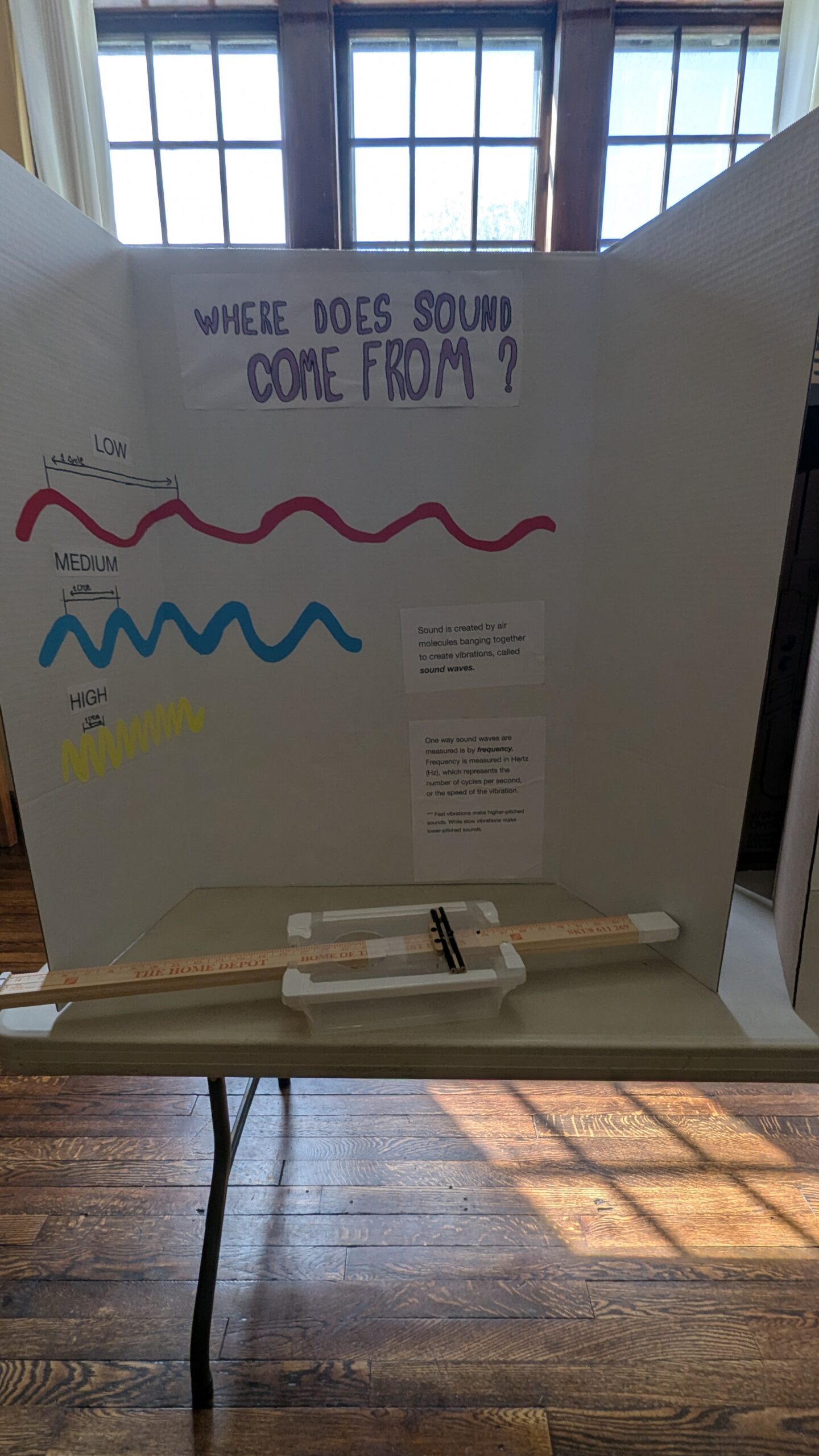
Rose took something you can’t hold in your hands — sound — and made it feel concrete. Her project had that rare “teach the room” quality: clear explanations, bright visuals, and one hands-on model that made everyone lean in.
Her board started with the foundation: sound begins when air molecules vibrate. From there, Rose explained pitch in a way that clicked fast — pitch is tied to frequency, measured in Hertz (Hz) (cycles per second). The wave diagrams (low / medium / high) were bright and easy to understand, like a little visual translator for something invisible.
And then she brought the concept to life with an interactive model: a homemade monochord built from a Home Depot yardstick and a resonator container. As Rose changed the tension and where the “string” was held, you could hear the science immediately — the same setup producing different tones, right in front of you.
What made the whole presentation feel special was how balanced it was: polished enough to follow at a glance, but still clearly handmade — the kind of board that made kids want to try it, and adults want to ask questions.
14) Coco — Soil Quality Study (solo)
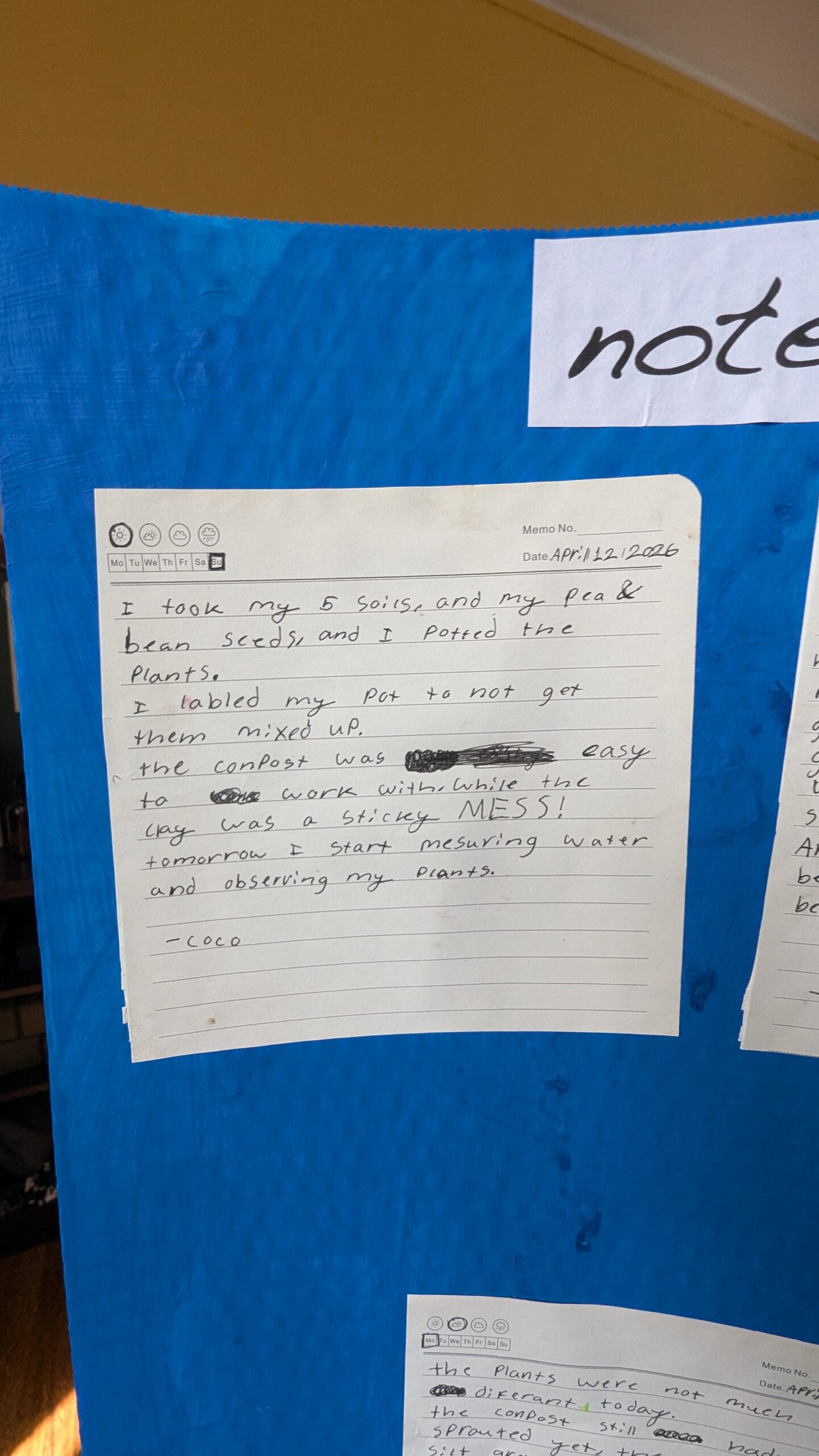
Coco’s project had the calm, grounded feel of a real garden — but underneath it was pure science: a fair test, careful notes, and the courage to let the plants tell the truth.
Using Contender snap beans and Oregon Giant snow peas, Coco set up the same basic growing conditions across five different soil types — compost, clay, silt, mountain dirt, and potting mix — and then tracked observations over time so the comparison wasn’t just a guess.
What made this one stand out was how clearly the results pushed back on expectations. Coco predicted that compost would be the clear winner and clay would struggle — and then, when the evidence didn’t match the prediction, Coco didn’t “explain it away.” They wrote one of the best lines of the whole fair: “My hypothesis is 100% WRONG!”
In Coco’s notes, silt and mountain dirt often outperformed compost, compost struggled more than expected, and clay stayed the most difficult soil to work with. That’s a genuinely grown-up conclusion: not just “what happened,” but which soil types surprised me, and how the data changed my mind.
In the end, Coco showed exactly what good science looks like: patient tracking, honest results, and the confidence to say, “I was wrong,” and mean it.
These spotlights aren’t here to rank projects — they’re here to honor them, and to celebrate what happened in that room: kids teaching everyone, and a whole community showing up ready to learn.
Again and again, presenters talked about the work that happened at home before the boards ever made it to SMCC: the trap-building and testing, the careful measuring, the resets and retries, the long waits, and the daily check-ins that turned “a project idea” into real evidence. Some experiments happened in minutes; others stretched across weeks — and one tiny, crystal-clear drop of filtered water took nearly a full day to appear.
Just as important was the quiet strength behind many of these projects: family buy-in. Parents and caregivers helped gather materials, make space for experiments, keep routines steady, ask good questions, and support the next step when a result didn’t go as planned. Not to “do it for them,” but to help them do it for themselves — and that kind of support is how confidence grows.
What we learned together was bigger than any single topic. We learned that good science is:
- Curiosity (asking a question worth testing)
- Fair tests (changing one thing at a time)
- Patience (letting the process take as long as it takes)
- Honesty (recording what happened, not what we hoped would happen)
- Courage (being willing to say “my hypothesis was wrong” and keep going)
That’s not just “school science.” That’s the beginning of how capable, thoughtful people are made.
The presentation boards will be on display during Spring Fling this Saturday, May 16.